 August 20, 2026
  3 min read
SEO has apparently died many times.
Social media was supposed to kill it. Voice search was going to replace it. TikTok became the new search engine. ChatGPT was expected to make traditional search irrelevant. Now AI Overviews and generative search are supposedly preparing the final funeral.
There is one problem with that argument: search still needs information, and information still needs credible sources.
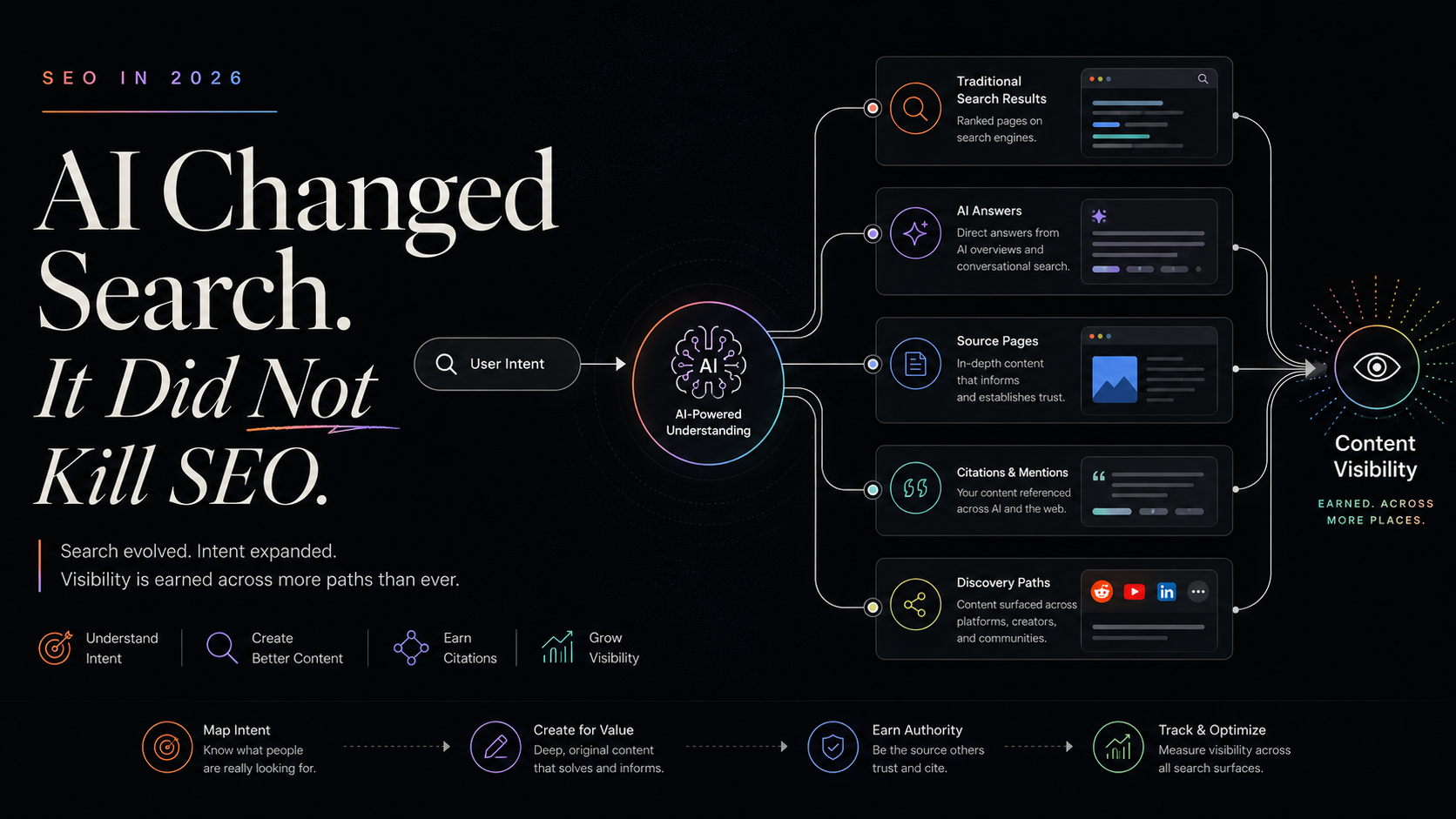
The real story of SEO in 2026 is not that it has disappeared. It is that search is becoming more sophisticated. Google now integrates generative AI experiences such as AI Overviews and AI Mode, allowing users to receive answers directly within search rather than simply choosing from a list of links.
That has naturally created a new industry around terms such as GEO and AEO. Some of the thinking is useful, but the fundamentals remain familiar. Search systems still need useful content, technically accessible websites and credible information they can understand and retrieve.
What has changed is the way that information is discovered.
Traditional SEO often focused heavily on individual keywords. AI-enabled search can examine a question from several directions at once. Someone searching for “What type of website does a growing hospitality company need?” may effectively be asking about mobile experience, booking journeys, website speed, conversion, SEO, content structure and hospitality UX at the same time.
This means ranking for one keyword is becoming a limited strategy. Businesses need to demonstrate expertise across an entire subject.
That also makes generic content increasingly less valuable. The internet already contains millions of articles such as “10 Benefits of Having a Website”. Generative AI can now produce similar content almost instantly.
What stands out instead is information that only your organisation can credibly provide: original research, project analysis, experiments, industry benchmarks, detailed case studies, technical discoveries and informed opinions supported by evidence.
In an AI-heavy internet, experience becomes a competitive advantage.
Technical SEO, however, remains essential. Great content hidden behind poor architecture is still difficult to discover. Clean site structure, internal links, descriptive titles, useful headings, indexable URLs, fast pages, strong mobile performance and structured data all help search systems understand and access information.
Structured data is particularly useful because it gives search engines clearer information about what a page contains. It does not magically create rankings, but it creates clarity, and clarity matters when machines are processing enormous amounts of information.
The way businesses measure SEO is also changing. Visibility is no longer limited to ten blue links. A brand may now appear inside an AI-generated response, image result, featured snippet, product result, video result or traditional listing.
The important question is therefore becoming less about “What position do we rank?” and more about “Where and how are people discovering us?”
A sensible AI-era SEO strategy is actually quite straightforward: create original expertise, answer meaningful questions deeply, build strong topic coverage, maintain excellent technical SEO, use structured data intelligently and measure how people are finding your business.
AI has changed how search presents information.
It has not changed why people search.
People still want answers, solutions, comparisons and guidance. Businesses capable of providing the most useful and credible information will continue to have an advantage.
The future of SEO is not about tricking machines into noticing you.
It is about becoming increasingly difficult for both machines and humans to ignore.