 August 20, 2026
  7 min read
Imagine walking into a beautifully designed luxury boutique. The interiors are immaculate, the lighting is carefully considered, the branding is impeccable and every detail has clearly been designed to create a premium experience. Then you approach a salesperson, ask a simple question and wait four seconds before they respond. You ask another question and the same thing happens. Four seconds of silence. Then another delay. It would not take long before the elegance of the space became irrelevant. The experience would simply feel frustrating.
Yet online, businesses routinely expect customers to tolerate exactly this kind of behaviour.
Website performance is still too often treated as a technical issue that belongs somewhere between the development team, server configuration and an occasional speed audit. In reality, it should be treated as part of customer experience. A website can have beautiful typography, impressive photography, sophisticated animation and exceptional branding, but if visitors have to wait for content to appear, buttons take too long to respond or the layout constantly shifts beneath their fingers, the experience begins to feel broken.
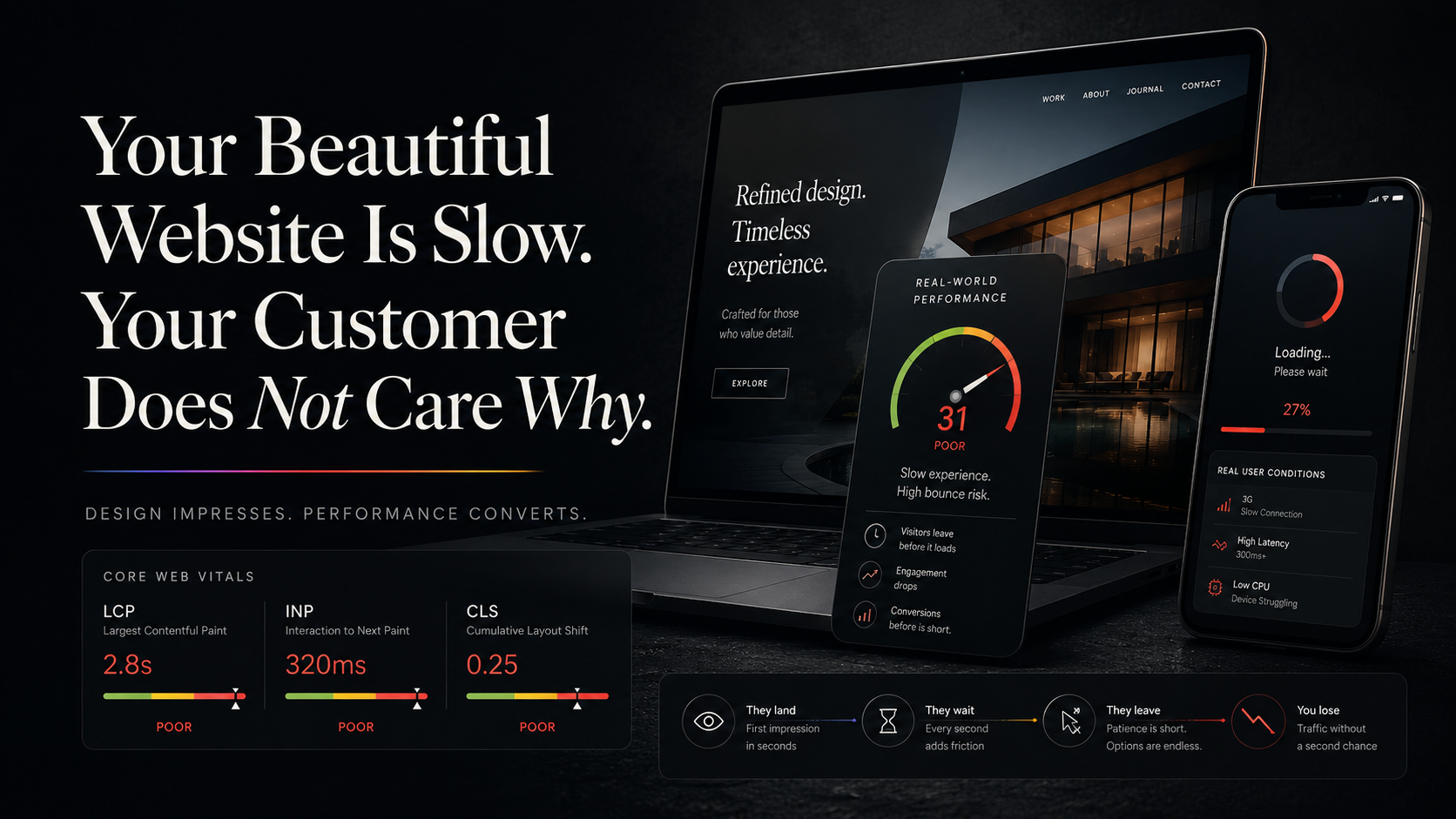
This is where Google’s Core Web Vitals become important. They are a set of measurements designed to assess important aspects of a visitor’s real-world experience on a website. The three principal metrics are Largest Contentful Paint, or LCP, which measures loading performance; Interaction to Next Paint, or INP, which measures responsiveness; and Cumulative Layout Shift, or CLS, which measures visual stability.
Google recommends that a good user experience should generally achieve an LCP of 2.5 seconds or less, an INP of 200 milliseconds or less and a CLS score of 0.1 or less. These standards are evaluated at the 75th percentile of page visits, which effectively means that a website should be delivering a strong experience for at least three out of every four visits.
These numbers can sound abstract and technical. Their effects, however, are extremely human.
Consider LCP. A customer visits a homepage, but the hero image is still loading. The main headline appears late. The central section of the screen remains empty for a moment too long. The user begins wondering whether something has gone wrong. That is not simply a loading metric. It is the digital equivalent of walking into a store and finding nobody at the counter.
Good website speed optimisation therefore begins with a simple question: what does the visitor need to see first? The most important information should be delivered as quickly as possible. Oversized images, slow servers, poorly configured hosting, render-blocking resources, unnecessary scripts and excessively complicated page construction can all delay that first meaningful impression.
Then there is INP, which measures how quickly a website reacts when someone tries to interact with it. A user taps the navigation menu and nothing happens. They tap again. Suddenly the menu opens and another action is triggered at the same time. The experience is remarkably similar to using a television remote whose batteries are almost dead: press, wait, press again and then watch everything happen at once.
Modern websites are especially vulnerable to this problem because they are frequently overloaded with JavaScript, analytics software, animation libraries, chat widgets, marketing trackers, personalisation systems and third-party integrations. Every individual tool may have a reasonable purpose, but together they can create the digital equivalent of a traffic jam. The site may technically function, but it no longer feels responsive.
Cumulative Layout Shift addresses another familiar frustration: the disappearing target. A visitor is about to tap a “Book Now” button when an image suddenly loads above it. The page moves. The button shifts position and the visitor accidentally taps something else. Perhaps it is a minor irritation on a content page. During checkout, a payment process, a lead-generation form or an important conversion journey, it can become far more damaging.
CLS attempts to quantify this unexpected visual movement. It reminds us that stability is not merely an engineering concern. It affects trust. Interfaces are expected to behave predictably. When they do not, the experience begins to feel unreliable.
This is why one of the strangest habits in digital projects is the tendency to treat design and engineering as two completely separate realities. Designers are often expected to create the experience while developers are expected to “make it work”. But loading behaviour is part of design. Responsiveness is part of design. Image optimisation is part of design. Mobile behaviour is part of design. The moment an interface is delivered to a real user, the boundary between aesthetics and engineering disappears.
A beautifully designed interface that performs badly is, in practical terms, badly designed.
Performance is also an important part of search infrastructure. Google has consistently encouraged website owners to create experiences that are secure, accessible, functional across devices and fast enough for users to navigate comfortably. Core Web Vitals are not the entire search ranking algorithm, and obsessively chasing a perfect performance score while ignoring poor content would make little sense. But technical SEO is fundamentally about removing obstacles between useful content and the people looking for it. Website performance is one of those obstacles.
There is another distinction businesses frequently overlook: laboratory performance is not necessarily real-world performance.
A developer may test a website on a powerful laptop connected to extremely fast broadband. The test results look excellent. The animations are smooth, pages load immediately and everything appears responsive. Meanwhile, the actual customer may be accessing the same website using a three-year-old Android phone on inconsistent mobile data while travelling between two locations.
These users effectively inhabit different digital worlds.
That is why real-world measurement matters. Actual website performance varies according to device capability, connection quality, browser conditions, background processes and the way people interact with a page. Performance analysis therefore becomes far more useful when it combines controlled PageSpeed testing with field data, Chrome user experience information where available, analytics, real-user monitoring, device-level testing and behavioural data.
A website should not merely perform well during a demonstration. It should perform well where customers actually use it.
One of the most effective ways of bringing this thinking into the design process is to establish a performance budget before the website is built. Instead of designing without constraints and attempting to optimise everything later, teams can treat performance as a resource that must be allocated carefully.
Before adding another autoplay video, custom font family, large animation library, background film or third-party widget, the team should ask two questions: What value does this element contribute to the experience, and what performance does it cost?
That creates a useful tension between creativity and efficiency.
The answer is not to turn every website into a plain, utilitarian page with no character. Premium brands still need emotion, visual richness, storytelling and distinctive design. But every digital flourish should justify the loading cost it places on the user. A beautifully produced video that causes the first screen to take several additional seconds to appear may be weakening the very brand experience it was supposed to enhance.
Interestingly, the ultimate goal is not actually speed.
The goal is effortlessness.
The best digital experiences feel natural because the technology seems to disappear. Pages appear when expected. Interactions respond immediately. Information remains stable. Customers can move through the website without having to think about what the system is doing behind the scenes.
They should be thinking about the product, the service, the proposition and the decision they are about to make.
They should not be thinking about the loading spinner.
For brands, this makes website performance much more than an engineering metric. It becomes part of conversion strategy, digital branding and customer experience. A faster response communicates competence. A stable interface creates confidence. A smooth journey reduces friction. These may be measured in milliseconds, but customers experience them as feelings.
And feelings ultimately shape how brands are remembered.
The milliseconds belong to engineering.
The feeling belongs to the brand.