 August 20, 2026
  4 min read
Branding says, “We should feel premium.” Marketing says, “We need conversions.” Development says, “That wasn’t in the scope.” The customer simply asks, “Why is this so confusing?”
That is the problem with organisational silos.
Businesses often buy branding, advertising, content, websites, applications and analytics as separate projects. Internally, that structure may make sense. Customers, however, do not experience departments. They experience one company.
That is why an integrated digital strategy matters.
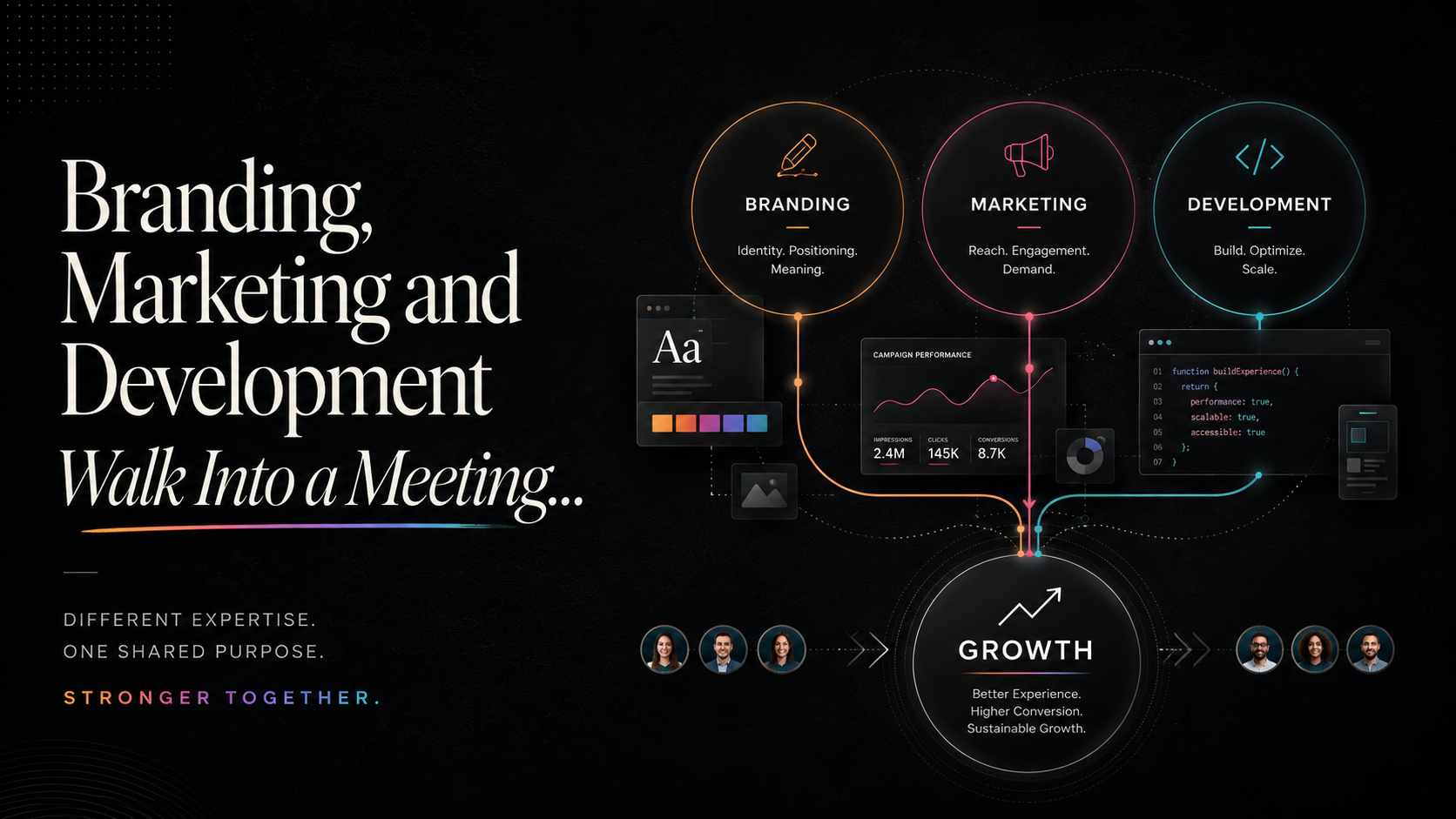
Branding creates the expectation. It defines what a business should mean, how it should sound, what it promises and why someone should choose it. Marketing then creates momentum through search, social media, content, email, paid advertising and other channels. Its job is essentially to say, “Pay attention. This may be relevant to you.”
Then the customer clicks.
At that moment, the advertisement disappears and the website becomes the brand.
This is where development becomes commercial strategy. Imagine an advertisement promising “Luxury made effortless” only to send users to a slow, generic landing page with a broken mobile layout and a twelve-field enquiry form. Marketing succeeded in generating attention. The experience failed to convert it.
The message before the click must survive after it.
A strong digital journey should move naturally from promise to proof, experience and action. If a campaign promotes simplicity, the website should feel simple. If an advertisement highlights one specific benefit, the landing page should continue that conversation. If a brand claims to be premium, every digital interaction should support that perception.
Customers do not distinguish between a marketing problem, a UX problem or a development problem. Friction anywhere belongs to the brand.
SEO demonstrates the same principle. It is still common for businesses to complete a website and then say, “Now SEO it.” But search performance is influenced by architecture, content structure, internal linking, mobile implementation, page speed and indexability, all of which are affected by decisions made long before launch.
SEO therefore works far better when it is considered during strategy, design and development rather than added as a final layer.
The commercial impact of connected thinking can be significant. Google has published case studies showing substantial improvements when technical SEO, content and user experience work together. Recruitment platform Saramin, for example, reported roughly twice the organic traffic alongside increases in sign-ups and conversion after SEO improvements. MX Player also reported major growth in organic search traffic after improving its video search implementation.
The specific numbers will differ for every business, but the underlying lesson is simple: visibility, experience and conversion are connected.
This becomes especially important when businesses spend heavily on advertising. Imagine investing ₹500,000 in campaign traffic. Marketing optimises the ads and generates clicks, but nobody takes responsibility for what happens once visitors arrive. Conversion remains weak, so management concludes that advertising is not working and spends even more money on media.
The real problem may have been the landing page all along.
This is why conversion optimisation requires shared information. Marketing teams should understand what visitors do after clicking. Designers should know what the campaigns are promising. Developers should understand which interactions have the greatest commercial importance. Brand teams should be able to identify where the experience stops matching the expectation.
Integration is not simply putting multiple departments inside the same agency or organisation. It happens when those disciplines actively improve one another’s decisions.
Developers should challenge design choices that damage performance. Strategists should challenge generic messaging. Analytics should challenge assumptions. Marketing insights should influence UX, and UX should influence campaign strategy.
That is how a digital system becomes smarter.
Customers never see the organisational chart. They only experience the outcome. They do not think, “The checkout is frustrating because another department built it.” They simply think, “This company is frustrating.”
Connecting branding, marketing and development therefore does more than create consistency. It closes the gap between what a business promises and what customers actually experience.
And that gap can be extremely expensive.
One business. One promise. One customer journey. One connected digital system.
That is not simply better organisation.
It is better business.